Introduction
My name is Kalyana. I took an astronomy course my senior year of high school and have enjoyed watching the show Cosmos from time to time for many years. I am a Psychology/Pre Med major and currently plan on attending medical school so that I can one day become a Psychiatrist. I am passionate about the over medication problem in the United States, and hope to contribute positively in ensuring patients aren’t over medicated and on the proper medications as well. I love toast and bagels, I love reading, I also have a cat named Pickles. I have no aim in taking this course other than purely curiosity and enjoyment. Quantum mechanics sparks my interest. While I am unsure as to whether anyone truly understands quantum theory, I am curious on the subject as it supposedly enables several of the fundamental processes of life.

Blog Post #2 (episode 1)
Something that particularly caught my interest is Voyager 1. Voyager 1 is a space probe that was launched in 1977 in order to further explore the cosmos. Voyager 1 is now the longest operating space probe, as we continue to receive signals from it 41 years later. As of January 2019, Voyager 1 has traveled 21 billion kilometers since its launch in 1977, further from Earth than any other man-made object.
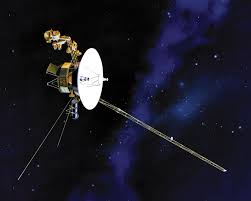
After learning more about Voyager 1, I was curious as to how far it would be able to travel before we lose contact with it entirely?
In order to answer this question I needed to learn how Voyager 1 receives and transmits signals to Earth from 21 billion kilometers away.
Earth transmits a 20 kilowatt signal to reach Voyager 1 through the use of radio waves. In approximately 20 hours, the data will reach the antennas on Voyager 1 to receive the data. Then, Voyager 1 begins to send data back to Earth while using a 20 watt signal. Unfortunately as it travels through space, its signal gradually weakens. When communicating with objects this far away, it matters less how strong the signals are, and more that the receiver is sensitive enough to pick it up.
Nasa uses the deep space network, which spends hours every day trying to detect even the faintest signals that could be transmitted from Voyager 1. However, our technology has advanced since 1977 drastically, so there is no limit as to how far we may be able to communicate with objects in space. With our current technology, we could potentially communicate with objects that are several light years away. That is, if our the receivers on the object are sensitive enough.
While we may have limitless potential in communicating with objects in space, we may only be able to communicate with Voyager 1 for a few more years. Voyager 1 is nuclear powered, so its power weakens with each day.
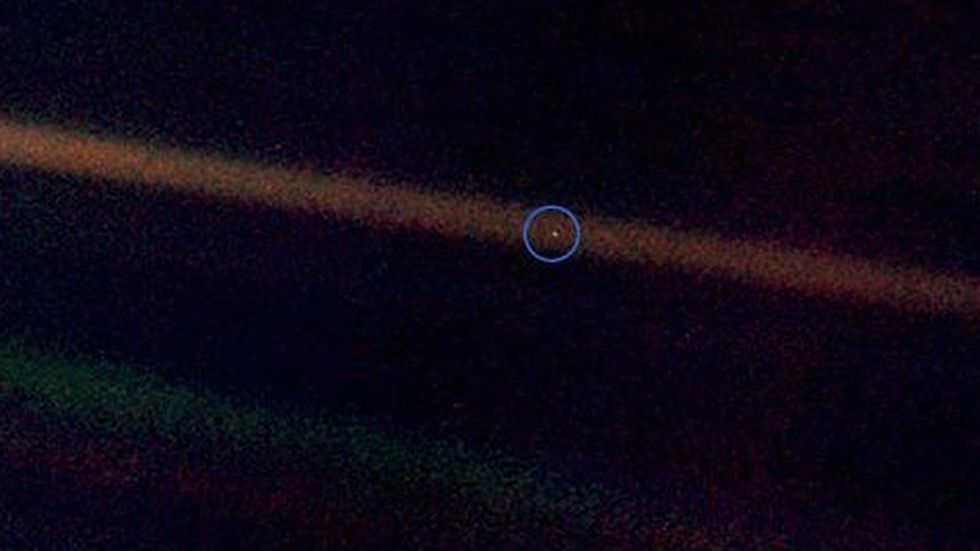
“Pale Blue Dot” image taken by Voyager 1.
This image displays Earth as a very small blue pixel surrounded by a boundless yet dark space.
Blog Post #2: Episode 2
The Cambrian Explosion
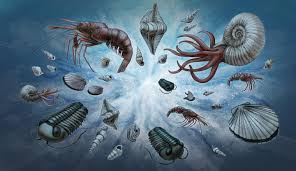
The Cambrian was a period with a wide range of happenings in it holding a most remarkable history in the life’s of the earth. Its sudden appearance of animals in fossils has led to an extinguished name for it known as the ”Cambrian explosion” also known as the big bang having phyla as the main animal present and class arthrpada as the extinct class and trilobite species as the most common. Its climatic condition was of a good and favorable condition especially for the life present at that time. The crustal breaking and formation during the Cambrian shaped the formation process of it making it a marine sedimentary rock with fossils in it. Its volcanic events also created some more events in it, giving it some mineral, new formations and texture.
Blog Post #3: Episode 3
Nicolaus Copernicus 1473–1543
(Also Kopernik) Polish astronomer and mathematician.
Copernicus is one of the extraordinary thinkers credited with inaugurating the Scientific Revolution in the sixteenth century with the publication of his De revolutionibus orbitum coelestium (On the Revolutions of the Heavenly Bodies, 1543). The revolution in science represents one of the greatest developments in the Western intellectual tradition. Thinkers such as Copernicus, the French philosopher Rene Descartes (1596-1650) and the British mathematician Sir Isaac Newton (1642-1727) departed radically from classical thought and from the ecclesiastical institutions of the Middle Ages. These thinkers brought about a change in the way people think and perceive both themselves and their place in the universe.
Blog Post #4: (Episode 4)
The Tunguska Event
Tunguska event, enormous explosion that is estimated to have occurred at 7:14 AM plus or minus one minute on June 30, 1908, at an altitude of 5–10 km (15,000–30,000 feet), flattening some 2,000 square km (500,000 acres) and charring more than 100 square km of pine forest near the Podkamennaya Tunguska River in central Siberia, Russia. The energy of the explosion is estimated to have been equivalent to the explosive force of as much as 15 megatons of TNT, a thousand times more powerful than the Atomic Bomb dropped on Hiroshima, Japan, on August 6, 1945.
Blog Post #5: (Episode 5)
Mozi (Mo-tzu, c. 400s—300s B.C.E.)
Mo Di (Mo Ti), better known as Mozi (Mo-Tzu) or “Master Mo,” was a Chinese thinker active from the late 5th to the early 4th centuries B.C.E. He is best remembered for being the first major intellectual rival to Confucius and his followers. Mozi’s teaching is summed up in ten theses extensively argued for in the text that bears his name, although he himself is unlikely to have been its author. The most famous of these theses is the injunction that one ought to be concerned for the welfare of people in a spirit of “impartial concern” (jian’ai) that does not make distinctions between self and other, associates and strangers, a doctrine often described more simplistically as “universal love.” Mozi founded a quasi-religious and paramilitary community that, apart from propagating the ten theses, lent aid to small states under threat from military aggressors with their expertise in counter-siege technology. Along with the Confucians, the Mohists were one of the two most prominent schools of thought during the Warring States period (403-221 B.C.E.)
Blog Post #6: (Episode 6)
The Enlightenment Period
The Enlightenment period was an extremely impactful revolution which caused changes in societies around the world. It began in 1651, people across the country took a stand against their unfair rights. In order to have a peaceful society, everyone must be treated with equality which can only occur if there is a fair government system in place. If people have to fight and kill to have their natural rights granted, something has to be done about it.
Blog Post #7: (Episode 7)
Christiaan Huygens
Dutch scientist Christiaan Huygens not only proposed the earliest theory about the nature of light, he also put optics to good use when he turned a telescope toward Saturn and observed that its odd blob-like shape, Galileo had first seen the shape in a telescope and drew it in his notebook as something like ears on the planet, was in fact caused by rings. Working as an astronomer, physicist, mathematician and inventor, Huygens made a number of important contributions to science.
Blog Post #8: (Episode 8)
Einstein’s Theory of Special Relativity
The theory of special relativity was developed by Albert Einstein in 1905, and it forms part of the basis of modern physics. After finishing his work in special relativity, Einstein spent a decade pondering what would happen if one introduced acceleration. This formed the basis of his general relativity, published in 1915.
The theory of special relativity explains how space and time are linked for objects that are moving at a consistent speed in a straight line. One of its most famous aspects concerns objects moving at the speed of light.
Simply put, as an object approaches the speed of light, its mass becomes infinite and it is unable to go any faster than light travels. This cosmic speed limit has been a subject of much discussion in physics, and even in science fiction, as people think about how to travel across vast distances.
Blog Post #9: (Episode 9)
Edward Kasner
Edward Kasner (April 2, 1878 – January 7, 1955) was a prominent American Mathematician who was appointed Tutor on Mathematics in the Columbia University Mathematics Department. Kasner was the first Jew appointed to a faculty position in the sciences at Columbia University. Subsequently, he became an adjunct professor in 1906, and a full professor in 1910, at the university. Differential Geometry was his main field of study. In addition to introducing the term “googol”, he is known also for the Kasner Metric and the Kasner Polygon.
Blog Post #10: (Episode 10)
Humphry Davy
Sir Humphry Davy was a Cornish chemist best known for his contributions to the discoveries of chlorine and iodine. In 1798, he was appointed chemical superintendent of the Pneumatic Institution to study the therapeutic uses of various gases, after which he made several reports on the effects of inhaling nitrous oxide (laughing gas). On a related front, in 1815, he invented the Davy lamp, which allowed miners to work safely in close contact with flammable gases. Davy was also a charismatic speaker, and his scientific presentations at the Royal Institution of Great Britain were extremely popular among Londoners of the day.
 Kalyana Gallagher's Blog for Cosmos